
2026 Wild River Resolutions
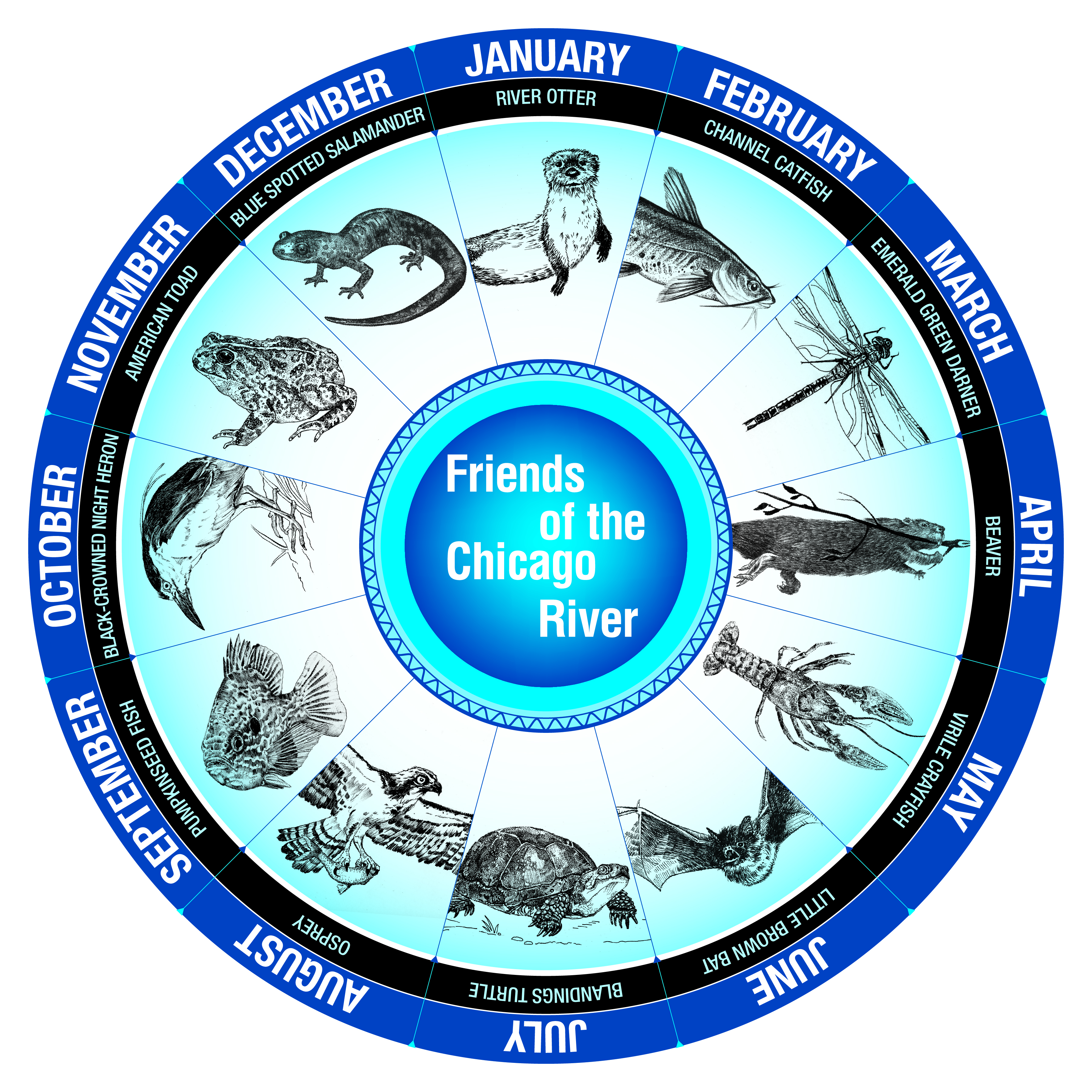
Friends of the Chicago River is kicking off 2026 by inviting people across the Chicago-Calumet River system to make Wild River Resolutions to learn more about the wildlife that depends on a healthy river. The award-winning organization has released Wild River Resolutions, a year-long profile of 12 native animals that call the river system home. Wild River Resolutions engages and educates people about the 156-mile river system and the species that rely on it, and how they can resolve to ensure a healthy, biodiverse, and accessible river matters for all people, water, and wildlife –month by month.
“The Chicago-Calumet river system is one of the nation’s greatest comeback stories, and it’s teeming with wildlife,” said Margaret Frisbie, executive director of Friends of the Chicago River. “Wild River Resolutions connects people to the animals living in and along the river and to the decades of work by Friends and our partners that transformed the river system into a healthy and biodiverse ecosystem that is worthy of everybody’s protection and care.”
A Wild River Renaissance—and Call to Get Involved
Friends of the Chicago River has been at the forefront of the river’s recovery for more nearly five decades. Through Friends’ policy and planning advocacy, education and restoration work, and key partnerships with nonprofit organizations and government agencies, the river system is cleaner, healthier, and more accessible than it has been in over 150 years. Wild River Resolutions highlights that progress by pairing each month with a native species that reflect the challenges and successes of river protection
and restoration.
January – River Otter (Lontra Canadensis)
Among the most heartening wildlife comebacks is that of the North American river otter. Once nearly extirpated from Illinois due to habitat loss and fur trapping, otters numbered fewer than 100 statewide by the late 1980s. Thanks to a statewide reintroduction effort in the 1990s, the species has rebounded and is no longer listed as threatened in Illinois, the success of which has been monitored in Cook County by the Forest Preserves since 2015. River otters have become a symbol of hope and renewal—so much so that the otter is the ambassador species for Friends’ major donor program, The Otter Society. Vital restoration, policy, and planning successes resulted in clean water, more and better habitat and the return of food sources have all contributed to river otter success.
February – Channel catfish (Ictalurus punctatus)
The channel catfish is once again abundant throughout the Chicago-Calumet River system and other local waters. Their presence can serve as a good monitoring tool for river health. Channel catfish prefer flowing rivers, yet can also be found in lakes, ponds and other slow-moving bodies of water generally where bottoms are sand, gravel, or rubble. In 2014, Friends of the Chicago River and the Illinois Department of Natural Resources (IDNR) installed over 400 channel catfish nesting cavities which we co-invented through a grant from the National Fish and Wildlife Foundation’s Chi-Cal Rivers Fund to mimic sunken logs and other habitat that male channel cats use to protect their eggs. Friends and IDNR also released 277,000 juvenile catfish into the North Shore Channel and Little Calumet River where the nesting cavities were installed. The project helps this critical species repopulate the system after years of degradation limited its breeding success.
March – Hine’s Emerald Dragonfly (Somatochlora hineana)
The Hines emerald dragonfly, once relatively common in the region but now endangered, is a large dragonfly found in calcareous (high in calcium carbonate) spring fed marshes and sedges meadows overlaying dolomite rock. They measure approximately 2½–3 inches in length and have brilliant emerald-green eyes, a metallic green thorax featuring two distinct yellow stripes, and a dark, slender abdomen. Highly effective predators, dragonflies can fly forwards, backwards, up and down, and hover and they can pinpoint insects an 1/8 of a mile away and catch them. Friends and the Forest Preserves of Cook County restored over 425 acres in the Crooked Creek subwatershed that particularly benefits Hine’s emerald dragonflies and red headed woodpeckers while capturing more stormwater and other benefits to the preserve and to the people who visit it.
April – Beaver (Castor Canadensis)
Among the largest mammals who live along the river system, an adult beaver can easily weigh over 40 pounds and be four feet long including their tails. They are semi-aquatic and have large, flat tails and webbed hind feet that make them excellent swimmers who can remain submerged for up to 15 minutes. Their eyes are covered by a third eyelid (called a nictitating membrane) which allows for underwater sight, and the nostrils and ears close when they are submerged. Beavers are nocturnal and active mainly at night. Beavers were very common throughout the country several hundred years ago but they were prized for their thick, warm fur, and by 1860, had all but disappeared from over-hunting. In 1950, the Cook County Forest Preserves began reintroducing beavers and, today, sightings are again common. Beaver research finds that beavers are effective hydro-engineers and shaped the American landscape creating and protecting ecosystems.
May – Virile crayfish (Faxonius virilis)
Quite common in the Chicago-Calumet River system, virile crayfish are native to the Great Lakes region and across many northern states. The virile crayfish lives in rivers, lakes, ponds and streams that do not freeze solid, and need rocks and vegetation to hide from predators and overwinter. Virile crayfish have brown to reddish brown bodies, are between 10-12 cm long and have a variety of leg types. Their front most legs are the two chelipeds, or large claws, which are a bluish color, and males typically have larger claws than females. After the claws there are four pairs of jointed legs known as pereiopeds which are used for walking, gathering food, and to hold the reproductive organs of virile crayfish. Next are five pairs of special legs used for swimming known as swimmerets or pleopods. Friends’ restoration projects have improved water quality for crayfish and their diet of plants and animals.
June – Little brown bat (Myotis lucifugus)
Found in many parts of North America, including most of the contiguous U.S. and parts of Mexico, little brown bats were once common in the Chicago-Calumet River watershed. They have large, furry toes and dark brown fur on their back. Incredible fliers who use echolocation to hunt their prey of as many as 1,000 insets a night, little brown bats tend to roost in caves, but can also be found in trees, under rocks, and in piles of wood in summer. These bats hibernate in caves, tunnels, and mines over the winter, although maternity colonies have also been found in buildings and other human structures as well as hollow trees. They mate in the fall, after which females give birth to a single pup in the spring. This bat’s population has been decimated by white-nose syndrome. As a result, their numbers have been dwindling and local researchers only record a few little brown bat calls each year. Friends has installed bat maternity colonies to augment reproductive habitat.
July – Blanding’s turtle (Emydoidea blandingii)
Classified as endangered in Illinois, the Blanding’s turtle is a Chicago-Calumet River system resident that is suffering from habitat fragmentation and loss, predation, and mortality from traversing roads. Once widespread, they are now restricted to a small number of states and provinces in the Upper Midwest, New England, and southeastern Canada. A late maturing, long-lived species, the Blanding’s turtle has demonstrated an inability to cope with events that reduce its population. The Blanding’s turtle is about the size of a small plate. Its most prominent identifying characteristic is their bright yellow chins and throats that makes them appear as if they smile all the time. Their dark shell has numerous, scattered yellow flecks. Wetlands, especially those with adjacent sandy uplands are necessary to support Blanding’s turtles, and restoration for them and reintroduction programs are underway.
August – Osprey (Pandion haliaetus)
Osprey are a distinctly marked and attractive raptor found on every continent except Antarctica including all throughout the Great Lakes and increasingly along the Chicago-Calumet River system. Fish make up 99% of the osprey’s diet. Once almost driven to extinction, ospreys all but vanished over 60 years ago due to habitat loss and widespread pollution in the 1950s and ‘60s. DDT, an insecticide banned in 1972, was especially damaging because it impaired ospreys' ability to absorb calcium, resulting in eggshells thinned to the point that they were crushed and the young could not survive. For over a decade, Friends of the Chicago River and the Forest Preserves of Cook County have installed osprey nesting platforms along the river system. Today, there are 21 nesting platforms across the forest preserves—five by Friends and 16 by the Forest Preserves. Friends’ advocacy for water quality improvements and instream habitat work supports the fish these majestic birds need to survive.
September – Pumpkinseed fish (Lepomis gibbosus)
Pumpkinseed are a variety of sunfish, which are a very important link in the river food chain. They consume smaller aquatic organisms to keep the Chicago-Calumet River system clean, and are, in turn, eaten by many species that live in or near the river. They are very common, although probably not as well-known as the bluegill, Illinois’ state fish. Pumpkinseeds are one of the most vibrant of our native freshwater fish. They are yellow, orange, or blue in color, with green and blue stripes over their sides and a yellow-orange underneath. The pattern of their scales resembles that of the sunlight reflected on the water’s surface and helps with camouflage. The pumpkinseed also has a prominent dark orange-red spot on the margin of their gills. When threatened by a predator, they flare their gills to make themselves seem up to four times larger than they actually are. Along their dorsal fins are 10 to 11 black spines. These spines are very sharp, which also aid the fish in defense.
October – Black-crowned night heron (Nycticorax nycticorax)
Once exceedingly rare, black-crowned night heron were listed as an endangered species in Illinois due to habitat loss. Today, they can be found all along the Chicago-Calumet River system where Friends of the Chicago River’s efforts to improve water quality and fish habitat has contributed directly to their return and success. Black-crowned night herons have a distinct and striking appearance. They are the shorter, stockier cousins of great blue herons and egrets. They can reach a length of 24 to 26 inches with a wingspan of two feet. Their resting posture is normally compact but when hunting they do extend their necks and look more like other wading birds. In 2010, a colony of roughly 100 members of this species began nesting at the southern end of Lincoln Park Zoo here in Chicago. The colony has grown to over 600 and is the largest colony in the state.
November – American Toad (Anaxyrus americanus)
American toads are common throughout the Chicago region and the 156-mile Chicago-Calumet River system. They can appear in a variety of shades of gray, greenish gray, brown, or even reddish brown. Black spots may be present along with a thin, light stripe down the back. Toads eat earthworms and a wide variety of insects, many of which are pests or annoyances to us and to our gardens. On summer nights, toads often catch and eat insects as they fall to the ground under outdoor lights. Toads can’t use their tongues to swallow. Instead they blink their eyes and the backs of their eyeballs roll into the roof of their mouths, pushing their food down their throats. Rather than drink water, toads absorb moisture through their soft belly skin where it contacts the ground. Unfortunately, this also makes them vulnerable to toxins and water pollution. Although toads prefer dry forests, their life cycle as amphibians keeps them tethered to ponds and rivers. Contrary to superstition, toads do not cause warts in humans.
December – Blue-spotted salamander (Ambystoma laterale)
Blue-spotted salamanders, whose bright blue coloring is extraordinary and a surprise on a cool forest floor, live in shallow burrows, under logs, rocks, or leaves across the greater Chicago area. The blue-spotted salamander is small, averaging about four to six inches in length. Like all salamanders, they are well camouflaged against the floodplain understory; dark bluish-black with pale blue patches on the belly and sides. Their diet varies, with blue-spotted salamanders eating spiders, insects, mites, earthworms, and leeches, and other annelids and arthropods. They are amphibians who absorb oxygen directly through their skin, which requires that they live near water in woody, swampy areas with sandy soil. Never pick up a salamander with your bare hands and then rub your eyes. Glands on the salamander’s tail produce a toxic liquid that is secreted when they are is threatened.
