In Defense of Biodiversity: 2026 Chicago-Calumet River Summit
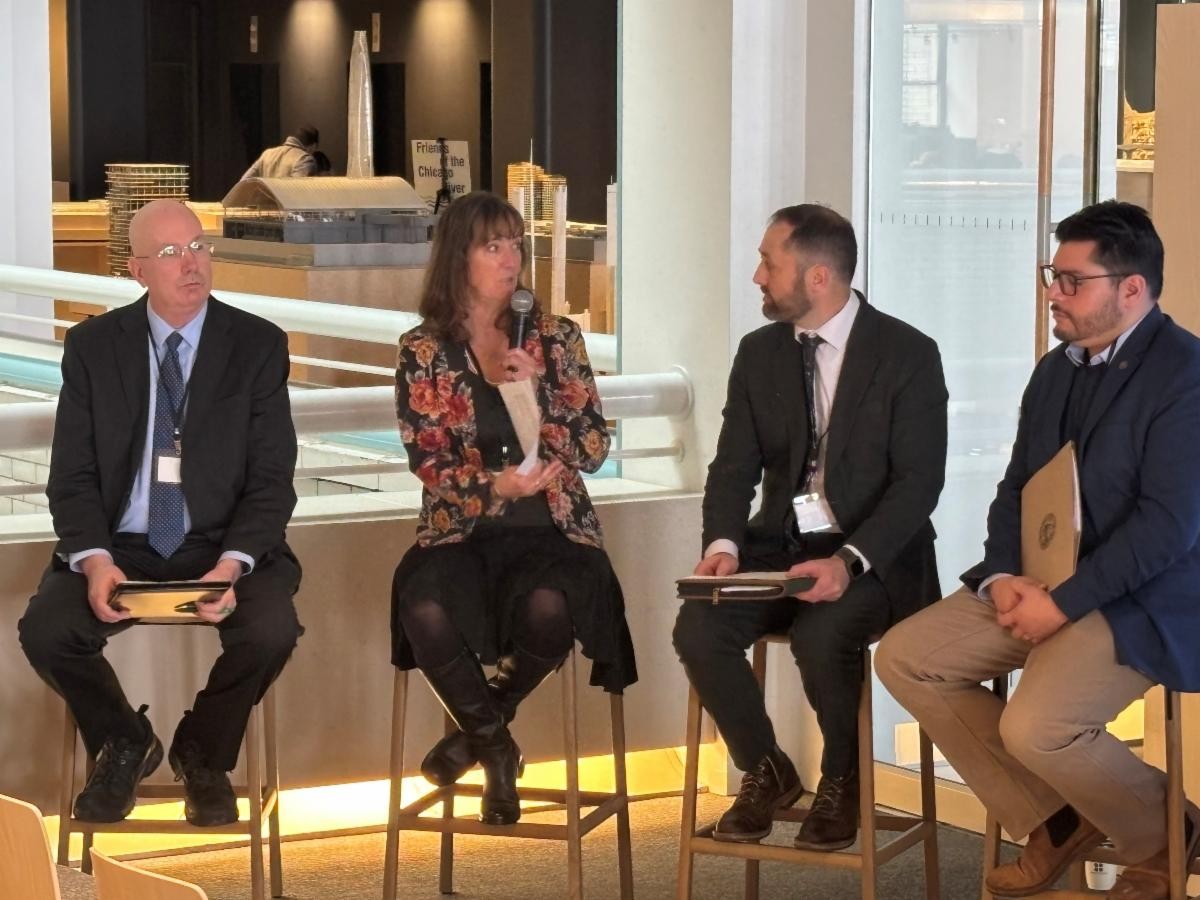 The state of biodiversity was the featured topic of a leadership panel with (left to right) the MWRD's John Murray, Friends' Margaret Frisbie, Adam Bianchi, of the Cook County Forest Preserves, and Carlos Ramirez-Rosa of the Chicago Park District.
Nearly 100 local, regional, and international experts gathered last week for the 2026 Chicago-Calumet River Summit, exchanging ideas, experiences, and perspectives at the region’s premier river-policy event, hosted by Friends of the Chicago River. The summit convened international and local leaders in science, policy, and community action around a timely and urgent theme: In Defense of Biodiversity.
Across a full day of conversation, the summit confronted the growing threats facing our environment and ecological health, from climate change, habitat loss, fragmentation, and weakened environmental protections, while spotlighting practical solutions making a difference. Attendees repeatedly emphasized the importance of regional collaboration and innovative partnerships to advance climate policy, biodiversity initiatives, and watershed planning throughout the Chicago-Calumet River system.
The program opened with a leadership panel featuring Adam Bianchi, general superintendent of the Forest Preserves of Cook County, Margaret Frisbie, Friends’ executive director, John Murray, executive director of the Metropolitan Water Reclamation District of Greater Chicago, and Carlos Ramirez-Rosa, general superintendent of the Chicago Park District, moderated by Juanpablo Ramirez-Franco of Grist and WBEZ radio. Panelists explored the escalating environmental crisis and discussed the essential role public agencies play in safeguarding wildlife, water, and the landscapes that support them. The conversation highlighted how coordinated action across agencies is critical to protecting biodiversity at the scale the moment demands.
“More and more…there is a deep understanding that people and ecosystems are interconnected,” said Bianchi. “When you think about the well-being of communities and ecosystems, there is strength in biodiversity.” Murray emphasized that green infrastructure plays an increasingly important role alongside the MWRD’s Tunnel and Reservoir Program in managing stormwater and addressing the impacts of climate change, including increased rainfall and flash flooding that threaten biodiversity. Highlighting the importance of this work, Murray noted the vital role of sustained green infrastructure investment, saying, “We have well over 200 different projects…that we’ve put in over the past 15 years. The beauty of green infrastructure projects is to help infiltrate water where it falls, keep it out of the sewer system.” Collaborating with the community is essential to “help people understand the benefit of biodiversity,” Rosa said. The Chicago Park District “stewards over 9,000 acres in Chicago”… and thanks to a lot of collaboration “2,000 acres are now natural areas where we are doing marshland restoration, prairie restoration, and really supporting important habitats.” He also noted the importance of environmental education at the park district’s three education centers across the city.
State-level policy took center stage in a talk by Jen Walling of the Illinois Environmental Council. Walling outlined current advocacy efforts to protect Illinois’ waters, including strengthened wetlands protections, PFAS contamination controls, and plastic pollution reduction. Her remarks underscored how to build power takes more than facts and figures but relationships and trust, as well sustained civic engagement to secure durable environmental protections. Walling noted that “votes are taken based on values, relationships and beliefs; votes are not taken based solely on facts and data.” In making your voice heard with lawmakers, Walling cited a Congressional study that said your relationships with lawmakers are what matters. The more in-person and personable you are with lawmakers, the more you influence them.
The summit’s keynote conversation featured Dexter Patterson of the Wisconsin Academy of Sciences, Arts & Letters, University of Wisconsin–Madison, and co-founder of BIPOC Birding Club of Wisconsin, who challenged attendees to rethink who feels welcome in nature. Patterson shared how inclusive approaches to conservation broaden the coalition needed to protect wildlife, restore trust, and ultimately build a more effective and resilient conservation movement. “The ones who are collaborating are the ones who are winning,” said Pattterson.
A science-focused panel moderated by Friends’ Kristine Lorenzo brought together Austin Happel of the Shedd Aquarium, Friends’ Director of Policy and Conservation John Quail, and Phil Willink of the Illinois Natural History Survey to examine how policy and habitat restoration have driven measurable improvements in fish diversity, abundance, and species richness across the Chicago-Calumet River system. Commenting on the theme of his work Willink said it “would be looking to see what particular [fish] species we find in a particular area, and if you understand the ecology of a particular species it tells us a lot about the health of that system and how the system functions.” Panelists imagined the next phase of the river renaissance: river beaches, reconnected habitat, and breaking down barriers between land and water. Happel commented that he would like to look at “creative ways that we could maybe bust down the barriers between land and water. What if we could think of new ways to develop shoreline? What if there’s ways to bring back connection to areas called backwaters, so small areas connected to the river, small ponds that are connected to the river?”
Additional speakers expanded the summit’s lens beyond the riverbanks. Catherine O’Reilly of the University of Illinois Chicago Energy Resources Center discussed right-of-way policies, conservation benefits agreements, and prioritization tools that support equitable, high-impact urban habitat siting. O’Reilly described the collaborative approach of the Right-of-way as Habitat Working Group where energy and transportation professionals as well as relevant stakeholders including different nonprofits and agencies [meet] with the overall goal of expanding habitat….”
Juan Carlos Bravo of The Wildlands Network highlighted efforts to restore cross-border habitat corridors across the U.S.–Mexico region, from re-establishing jaguar pathways to advancing wildlife-safe infrastructure and binational partnerships, reminding us that “conservation is like science fiction: you have to imagine a different future.” Closing the program, Sunny Nelson of the Lincoln Park Zoo connected global biodiversity research to local conservation action, showing how insights on genetic diversity and climate-driven threats inform everyday work in Chicago.
Friends of the Chicago River extends our sincere thanks to the summit’s host Skidmore, Owings & Merrill (SOM) and our generous sponsors, Reyes Coca-Cola Bottling, Niagara Cares, Christopher B. Burke Engineering, Resource Environmental Solutions, Stantec, Baxter & Woodman, and Arcadis, whose support made this critical gathering possible. Together, the 2026 Chicago-Calumet River Summit reaffirmed a shared commitment to protecting biodiversity and building a healthier, more resilient river system for people, water, and wildlife.
