Long-term Action and Advocacy to Address Contaminated River Sediment
Long-term Action and Advocacy to Address Contaminated River Sediment
After decades of progress improving the Chicago-Calumet River system, federal and local agencies are pursuing an opportunity to take a more holistic approach to restoring the waterways, including addressing legacy contamination, improving aquatic habitat, and expanding opportunities for recreation. The U.S. Army Corps of Engineers (USACE) is working with local partners on a system-wide study that could lay the groundwork for future restoration projects across the Chicago and Calumet rivers. But advancing that work will require additional federal funding and matching commitments from non-federal partners.
Congressional action will be critical to securing the federal share needed to move the next phase of this work forward. Advocates can help by making clear to elected officials that restoring the Chicago-Calumet River system, and addressing the legacy pollution that continues to affect it, should be a priority. That need is especially clear in places where the effects of historic pollution remain visible and continue to limit the river’s ecological health and public use; Bubbly Creek, on the South Branch of the Chicago River, provides a powerful example of both the challenges facing the river system and the progress that sustained investment and advocacy can achieve.
A Vision for Restoration
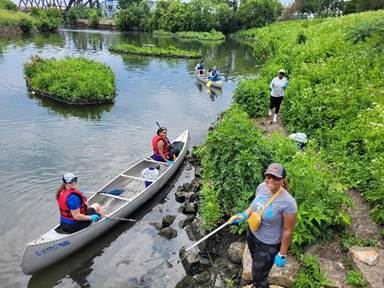
Photo: Friends of the Chicago River volunteers pick up litter on Bubbly Creek.
Recognizing the creek's ecological potential, Friends of the Chicago River, the City of Chicago, USACE, and other partners launched the Bubbly Creek Recovery Initiative in 2004 to lay the groundwork for restoring habitat, improving aquatic conditions, and reconnecting people with this historic waterway. The initiative established a vision for restoring native habitat, enhancing in-stream structure, and creating healthier conditions for fish, wildlife, and migratory species increasingly threatened by habitat loss and climate change.
That vision advanced in 2015, when USACE released a proposed restoration plan for public review and comment. The plan identified opportunities to address erosion, poor water quality, and limited aquatic and shoreline habitat along Bubbly Creek while improving conditions for fish, wildlife, and migratory birds and enhancing opportunities for people to experience the waterway. USACE accepted public comments on the proposal, marking an important step toward developing the restoration project that would later receive congressional authorization.
A major milestone came in 2021 when Congress authorized $11.6 million for the USACE National Ecosystem Restoration Project at Bubbly Creek, with an additional $6.2 million committed by the City of Chicago as the local sponsor. The proposed 44-acre restoration project would improve aquatic habitat and address decades of environmental degradation. However, implementation has been delayed because unresolved environmental liability associated with the contaminated sediments has prevented the project from receiving final federal appropriations.
The Legacy Beneath Bubbly Creek
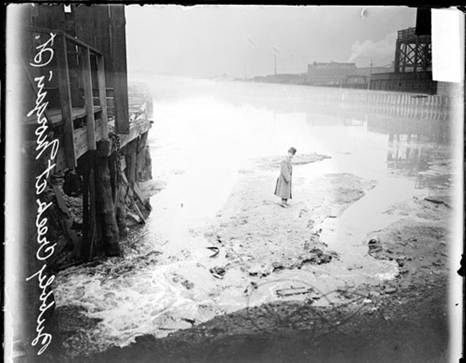
Photo: An early 20th Century image of a man standing on Bubbly Creek which was loaded with industrial waste and organic waste from animal parts.
Bubbly Creek provides a powerful example of both the challenges facing the river system and the progress that sustained investment and advocacy can achieve. Bubbly Creek, the South Fork of the South Branch of the Chicago River, is one of the most well-known waterways in the Chicago-Calumet River system. During the height of the Union Stock Yards operations, decades of animal waste, industrial pollution, and sewage settled to the bottom of the creek, creating a thick layer of contaminated, oxygen-depleting sediment that remains today. As this organic material decomposes, it releases methane and hydrogen sulfide gases that give Bubbly Creek its name. Heavy rain events and combined sewer overflows (CSOs) can further disturb these legacy sediments while also introducing additional pollutants into the waterway, underscoring the need to address both historical contamination and ongoing sources of pollution.
Coalition Urges Action
In 2024, recognizing that sediment contamination had become one of the primary barriers to restoration, the U.S. EPA Great Lakes National Program Office (GLNPO) began evaluating options to remediate contaminated sediment while restoring habitat and improving dissolved oxygen conditions in the creek. Building on that momentum, Friends of the Chicago River rallied 18 environmental organizations in January 2025 to urge U.S. EPA Region 5 to invest Great Lakes Restoration Initiative (GLRI) funding in contaminated sediment cleanup throughout the Chicago-Calumet River system, including Bubbly Creek. While the system is not officially designated as a Great Lakes Area of Concern, it shares many of the same legacy contamination challenges. The coalition encouraged U.S. EPA to use GLRI funding and the Great Lakes Legacy Act's cost-share program, which supports contaminated sediment cleanup through federal and non-federal partnerships, to begin addressing these long-standing environmental issues through partnerships with federal, state, local, and private entities.
Progress Continues
In February 2025, U.S. EPA GLNPO responded by announcing a series of actions focused on Bubbly Creek. The U.S. EPA committed to advancing work where it could have the greatest immediate impact by:
- completing a pre-design investigation to characterize contaminated sediment;
- funding a pilot sediment capping project informed by that investigation;
- using the results to refine and advance the U.S. Army Corps of Engineers' National Ecosystem Restoration Project; and
- incorporating Chicago Area Waterway System projects into the updated Lake Michigan Lakewide Action and Management Plan (LAMP).
Now, that work is underway: U.S. EPA GLNPO provided an update on the Bubbly Creek Pre-Design Investigation at the June 2026 meeting of the City of Chicago’s River Ecology and Governance Task Force which is a collaborative forum hosted by the City’s Department of Planning and Development with facilitation support from Friends of the Chicago River. The Task Force brings together government agencies, civic and nonprofit organizations, private developers and local communities to advance shared goals for improving and sustaining the health and vitality of Chicago's rivers.
Scientific Evaluation
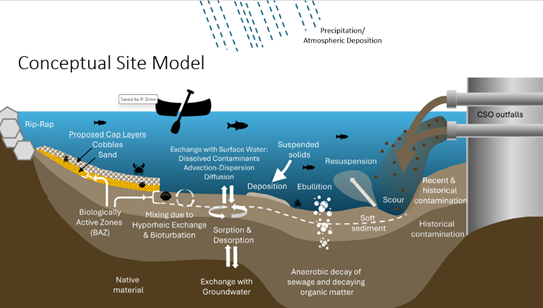
Illustration Source: Presentation by EPA-GLNPO at June 2, 2026 River Ecology and Governance Task Force Meeting
The investigation is providing the scientific foundation needed to move the long-planned restoration project into the engineering design phase. U.S. EPA is characterizing contaminated sediments across approximately 22 acres of Bubbly Creek, studying groundwater and surface water interactions, measuring sediment accumulation and contaminant movement, and collecting field data to address critical information gaps. The agency is also developing a conceptual site model and contaminant fate-and-transport models to evaluate how restoration actions, including a potential sediment cap, could improve water quality and habitat over time.
U.S. EPA also emphasized why restoration remains so important. While Bubbly Creek now supports turtles, hawks, migratory birds, and other wildlife, it still lacks the habitat structure necessary to sustain a healthy aquatic ecosystem. Legacy organic sediments continue to generate methane and hydrogen sulfide gases that create the creek's signature bubbles, odors, and floating sludge, while storm events and combined sewer overflows continue to affect water quality and hydrology. So far in 2026, we have had nine combined sewer overflow events discharging into Bubbly Creek resulting from Metropolitan Water Reclamation District (MWRD)’s Racine Avenue Pumping Station.
Field investigations will continue through 2026, with sediment samplers remaining in place to capture seasonal conditions before models are updated and a final report is completed in 2027. Those findings will help refine the restoration design and move the USACE ecosystem restoration project one step closer to implementation, bringing decades of planning, scientific study, and advocacy closer to achieving a healthier, more resilient Bubbly Creek.
System-wide Evaluation
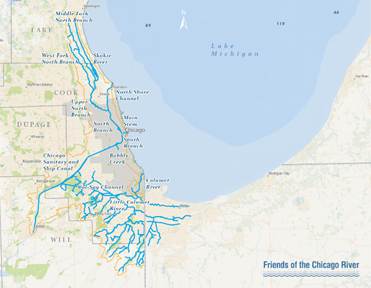
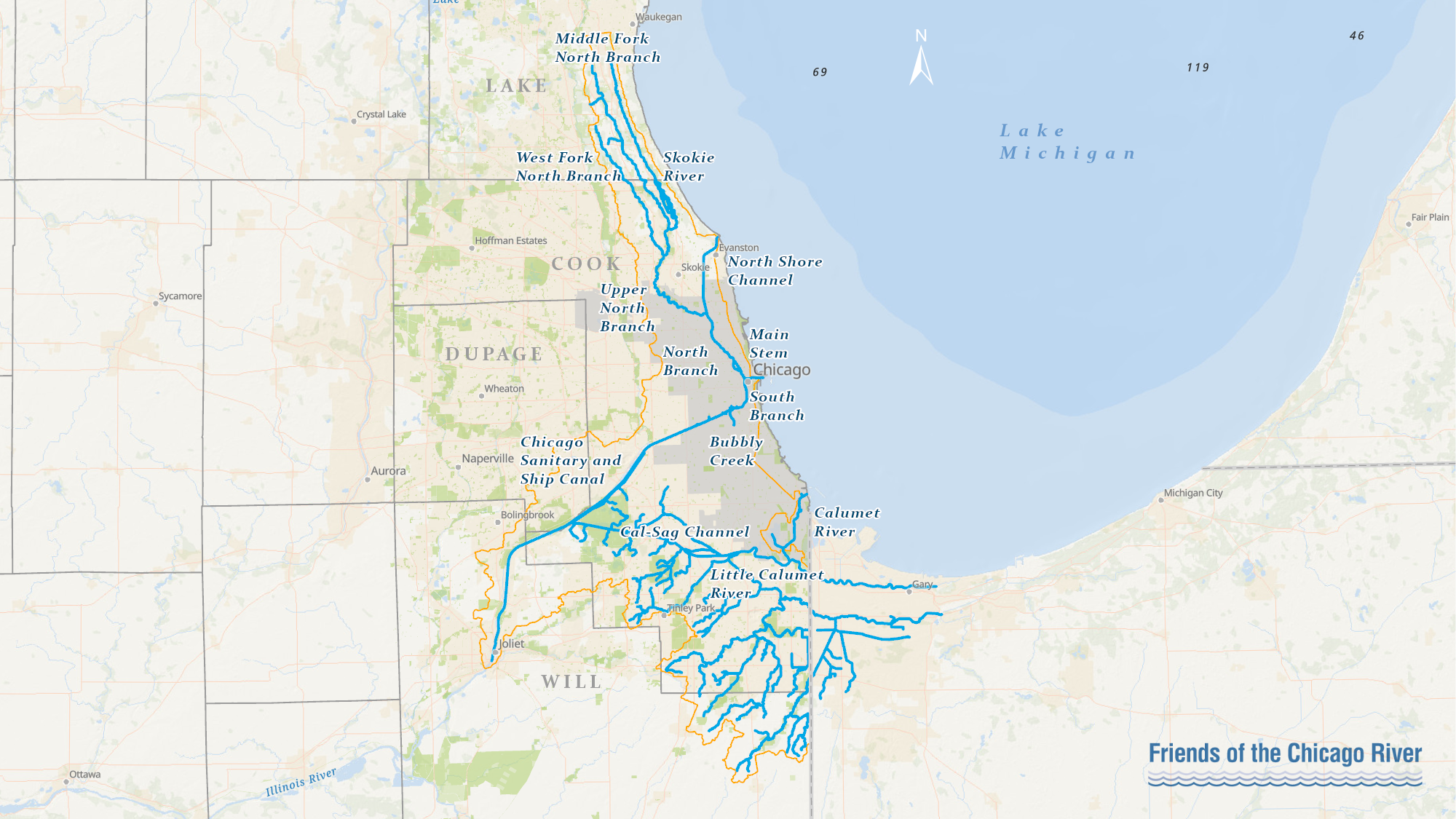
Illustration: Chicago-Calumet River watershed
While U.S. EPA GLNPO is leading the contaminated-sediment investigation underway at Bubbly Creek, USACE is leading a separate, broader effort to identify restoration opportunities across the Chicago-Calumet River system. Together, the efforts illustrate the potential to move beyond individual projects toward a more comprehensive approach to restoring the region's waterways.
USACE's Chicago Area Waterways System Restoration and Recreation Study is examining opportunities to restore aquatic habitat and expand public access and recreation across the Chicago and Calumet rivers. The study builds on decades of improvements to the waterways and could lead to future federally supported restoration projects throughout the system. Cleaning up legacy contamination poses a barrier to restoration could improve ecological health while also expanding opportunities for recreation such as boating and fishing.
The study has gained strong local support in 2026 through resolutions adopted by the MWRD, the City of Chicago, and Cook County under the leadership of MWRD Commissioner Cam Davis. Advancing the next phase of the USACE effort will require federal funding as well as cost-sharing from non-federal sponsors. Those non-federal partners include the Chicago Department of Planning and Development (DPD), Forest Preserve of Cook County, Chicago Park District, MWRD, and the Illinois Department of Natural Resources. Securing those commitments is a critical next step toward evaluating priority restoration projects and positioning the Chicago-Calumet River system for future federal investment.
“Thanks to the leadership of Friends of the Chicago River and so many other Chicago area advocates, a holistic cleanup of the River System, led by the feds, could be within reach,” said Cam Davis, MWRD commissioner who has championed the effort at MWRD, and with the City and County. “This is our generation’s chance to keep from kicking the can down the road yet again to other generations.”
Now the challenge is turning that opportunity into action. Congress must provide the federal resources necessary for USACE to continue the work, while non-federal sponsors must provide their required share through a cost-share agreement. Advocates can help move this system-wide effort forward by making their voices heard and urging elected officials to secure the resources necessary to advance it.
The work underway at Bubbly Creek shows what sustained advocacy, scientific investigation, and public investment can make possible. But Bubbly Creek is only one part of a much larger river system. Friends of the Chicago River is committed to building on that progress and advocating for the resources and partnerships needed to address legacy pollution and restore the Chicago-Calumet River system for people, water, and wildlife.
