
How Does Chicago River Water Quality Compare to Lake Michigan?
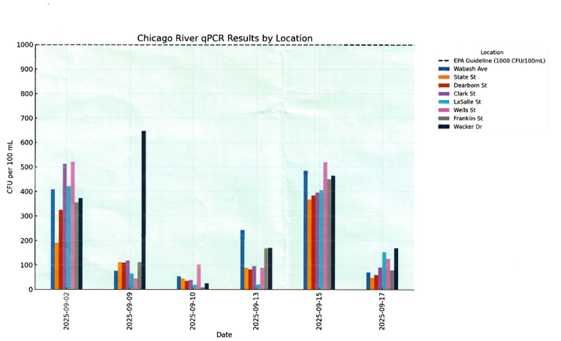
Image: Public health researchers monitored bacterial levels beneath seven bridges along the Main Stem of the Chicago River on six occasions leading up to the 2025 Chicago River Swim. None of the samples measured anywhere near the 1,000-per-100 mL benchmark considered safe for swimming shown, as shown in the analysis. Source: University of Illinois Chicago School of Public Health
Water-quality Monitoring Reveals a Healthy River for Swimming
When nearly 300 swimmers took to the Chicago River on September 21, 2025, they were swimming in a river that decades ago few could have imagined would host an open-water swim. But what was the water quality actually like? It was as good as swimming in Lake Michigan.
Following the same protocols that they use for the Chicago Park District to monitor water quality at Chicago’s Lake Michigan beaches to determine whether conditions are appropriate for swimming, University of Illinois Chicago School of Public Health epidemiologists sampled river water beneath eight bridges along the Main Stem (Wabash, State, Dearborn, Clark, LaSalle, Wells, Franklin, and Wacker) on six separate days between September 2 and 17. Every day every sample was well below the Beach Action Value benchmark of 1,000-per-100 mL, meaning the water quality met the swimmable standard. None of the samples would have triggered a water-quality swim advisory which applies the same standard at Chicago’s Lake Michigan beaches.
This consistent finding across eight locations and six separate sampling days gives us a glimpse at just how far the Chicago River has come. The results do not mean the Chicago River is ready for swimming everywhere, every day. Like Lake Michigan, river water quality changes with conditions. Heavy rainfall and combined sewer overflows can rapidly increase bacterial contamination, which is why making routine river swimming possible will require reliable monitoring and continued infrastructure improvements such as designated swimming areas, safe access points, ladders and other means of entering and exiting the water, and facilities that protect swimmers from boat traffic.
Chicago’s Place in the Global Urban Swimming Movement
The question is no longer simply whether people can ever swim in the Chicago River. Swimming was approved as a legally designated use in much of the river system by the Illinois Pollution Control Board and USEPA in 2011. And, we now have real-world water-quality data, the Chicago River Swim, and the experience of communities around the globe working to reclaim their urban waterways for swimming to show us what should happen now. The next hurdle is what it will take to make a swimmable river a lasting part of our watershed’s future. As the Chicago region faces hotter summers and increasingly frequent extreme heat, creating more places for people to safely access and cool off in the water is also a matter of climate resilience and equity.
This is the conversation we will continue at the Chicago-Calumet River Swimming Summit: Jumping Back In on January 28 at the Peggy Notebaert Nature Museum. Join us and get more info here.
